
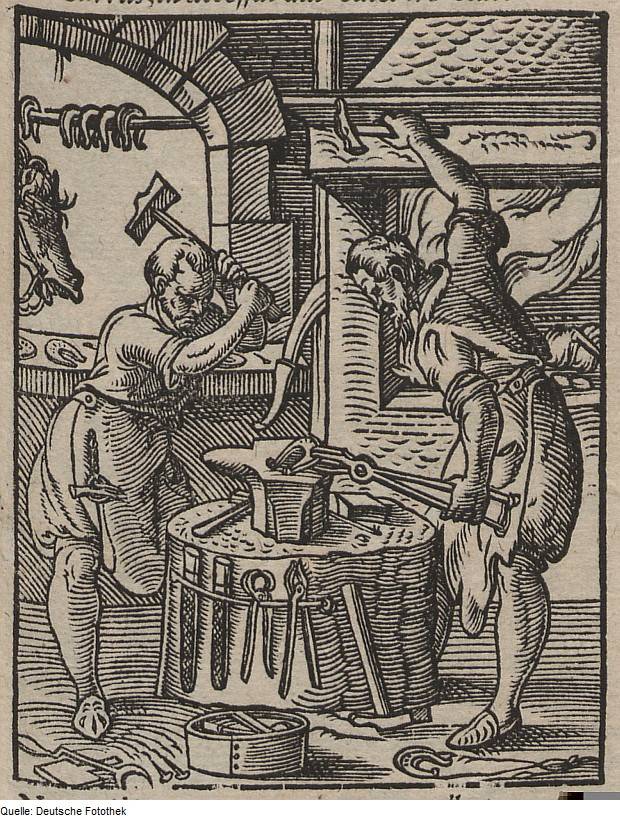
The smith's workshopA master, two apprentices and a forge made every tool in town.
BottegaOne person and a laptop now make what used to take a film crew. See how →The film is AI-generated; the bakery and baker are invented.

[1] “Faber est suae quisque fortunae”: everyone is the maker of their own fortune. Attributed to Appius Claudius Caecus, Roman statesman, about 300 BC.
The smith's workshopA master, two apprentices and a forge made every tool in town.
BottegaOne person and a laptop now make what used to take a film crew. See how →The film is AI-generated; the bakery and baker are invented.
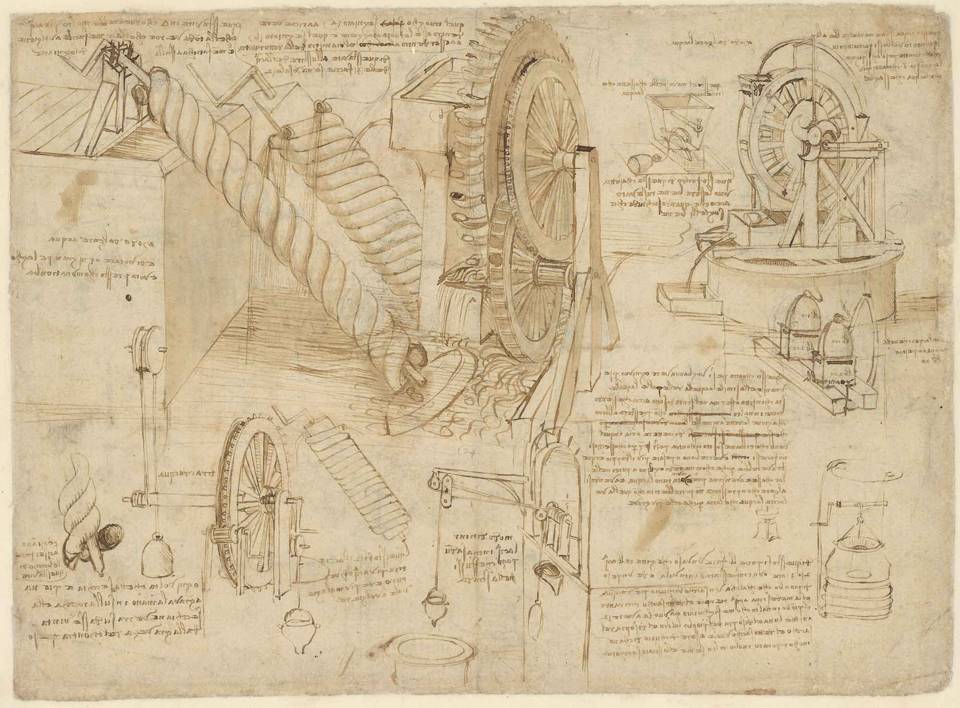
The notebookLeonardo drew, measured and invented in the same pages.
The next toolsEvery single resource a solopreneur would need. One person, no middleman.
In 1568 a printer in Frankfurt published a book of woodcuts showing every trade of the town, each one a person working with their own hands. Most of those trades needed a workshop, a guild and years of apprenticeship before one person could make a living from them.
The workshop now fits in a laptop. AI tools can draw, film, write and build, and one person can direct them all. But they reached engineers and big companies first. Most people have never had the tools, the training or anyone to show them what is possible.
Manu Propria is for everyone else: the shop owner who needs an ad, the person with a story in their head, anyone who never thought of themselves as technical. We make plain, step-by-step guides that put these tools in your own hands, so you can make whatever your mind comes up with. We start with film.
Reel and images, all public domain: Charles Rochussen, De hoefsmid (The Farrier) (1876); Jost Amman, Faber. Der Schmid. (The Smith), from the Ständebuch (1568); Diderot and d’Alembert, eds., Plate from the Encyclopédie, vol. 3 (1763); Leonardo da Vinci, Presumed self-portrait (c. 1512); Leonardo da Vinci, Design for a flying machine (flapping wings), Codex Atlanticus f. 858r (c. 1485–90); Albrecht Dürer, Praying Hands (1508); Dickenson V. Alley, Nikola Tesla with his equipment, Colorado Springs (1899); William Blake, Newton (Newton measuring with compasses) (1795–c. 1805); Leonardo da Vinci, Codex Atlanticus, f. 26 verso (c. 1480); Gabriel Metsu, De wapensmid (The Armourer) (1650–60); George Hendrik Breitner, Hoefsmid met schimmel (Farrier with a grey horse) (1880–1923); Leonardo da Vinci, A study for an equestrian monument (RCIN 912341) (c. 1517–18); Isaac Newton, Philosophiæ Naturalis Principia Mathematica, title page (1687); Unknown artist, The Holy Family in Joseph’s workshop (RP-T-1905-69) (1747–1812); Sarony studio, Nikola Tesla holding one of his wireless glowing lamps (c. 1898); Nikola Tesla, Fluid propulsion (turbine), US Patent 1,061,206 drawing (1909); Johannes Vermeer, Het melkmeisje (The Milkmaid) (c. 1660); Leonardo da Vinci, A study of seated figures in conversation (RCIN 912702) (c. 1480); Unknown artist, Carpenter seated at a workbench in his workshop (RP-T-FM-144) (1861); Johannes Vermeer, The Lacemaker (c. 1669–71). Film, from the Prelinger Archives (public domain): Flatboatmen of the Frontier (1941), The Machinist and Tool Maker (1942), Master Hands (Part I) (1936), Caught Mapping (1940). Photographs of artworks courtesy of the institutions named in our source list; the flapping-wing photograph is by Luc Viatour. The “Now” film is AI-generated; its bakery and baker are invented.